Top 100 Trial Lawyers
BBB
Top 40 Under 40
AV Preeminent
The National Trial Lawyers
Top Once Percent
USCCA
LawyerCentral.com
AVVO
AVVO
USCCA
Badge
Best DWI Attorney 2017
10 Best Law Firm

We wrote a very popular blog about whether you can take your lawfully possessed pistol on vacation with you in Puerto Rico, subsequent to the easing of gun laws in Puerto Rico.  Now we explore the gun laws in the US Virgin Islands and in particular whether you can take your pistol to St. Thomas, St. John and St. Croix.

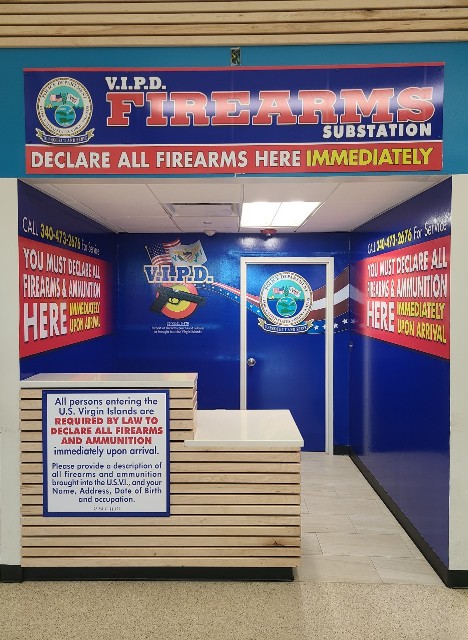
At first glance, the US Virgin Islands appears to have extremely liberal reciprocity laws however that appears to be far from reality.  A review of the USVI Police website clearly indicates that visitors are required to declare their firearms before arrival in the US Virgin Islands and to immediately report to the US Virgin Island Police Substation upon

FirearmsSubstationSTT-219x300

USVI Police Airport Substation

In a recent New York case involving a defendant who was convicted of possession of a controlled substance and criminal possession of a weapon, the court reversed the original lower court’s guilty verdict. On appeal, the defendant argued that incriminating evidence found by police officers should have been suppressed since the officers did not have reason to believe they could search through his private apartment. The court agreed with the defendant, reversing the judgment in the case.

Facts of the Case

According to the opinion, police officers originally responded to a 911 call made by a woman who reported that her roommate was unconscious on the floor of their apartment. A team of officers and medical personnel arrived at the apartment and discovered that the unconscious woman had died on the floor of the bathroom.

Soon after discovering the woman was dead, an officer decided to conduct a brief search of the residence. As he looked around, he found a digital scale, some powdery residue, and a bag with illegal drugs in the bedroom. Based on these findings, officers proceeded to obtain a warrant to search the entire apartment. They found not only illegal drugs but also a handgun, and the defendant was ultimately charged and convicted for criminal possession of a controlled substance in the first degree and criminal possession of a weapon in the second degree.

Continue reading

New York criminal law has a large number of crimes related to illegal gambling on the books.  Beginning January 8, 2022,  the New York gaming commission gave their approval to four operators to start taking online bets from anywhere in the State including from a person’s own living room a bar or from the street.  New York appears to be at least the 18th State to approve some form of online sports betting which has become increasingly popular in the last few years.  New Jersey, Pennsylvania and Connecticut already allow  online sports betting.  sports-betting-300x200

Last April, then Governor Cuomo authorized the New York State Gaming commission to start approving online gaming licenses as part of the State budget in an attempt to get such much needed extra revenue after the COVID lockdowns.  New York is taxing gross revenues made by online betting operators at a whopping 51% which is significantly higher than other States and is likely to generate significant revenue for New York.

The way was paved for online sports betting in New York in 2018 when the United States Supreme Court struck down a Federal ban on sports betting.  In 2019, New York allowed its brick and mortar casinos to start taking sports bets.  The problem is that the New York State Constitution bans gambling.  This means that even the Governor could not pass a law that allows online sports betting.  However, the Constitutional ban has several exceptions including the State Lottery, Horse Racing and up to 7 private casinos.  No exception is made for online gambling.  However, the State found a work around.  They will be storing the servers for the online sports betting at one of the 7 private casinos that is already authorized to operate in New York.

As New York gun rights attorneys we are carefully monitoring an increasing regulatory environment of everything related to firearms and an increasing number of gun owners who are receiving letters from law enforcement.    Recently we were consulted by a person who received a letter from the Federal Bureau of Alcohol, Tobacco, Firearms and Explosives (ATF) concerning a solvent catcher that he had purchased years ago.

The problem arises due to the National Firearms Act (NFA) which put suppressors or silencers as they are commonly known in the same category of fully automatic machine guns and sawed off shotguns, making them highly regulated and requiring a background check, tax stamp, and long wait to legally own.  The do-it-yourself market which has become a lucrative market in general has also become popular among firearms enthusiasts many of whom enjoy building, modifying and customizing firearms and gun parts.  The same is true for the suppressor industry.

In an August 2019 article in the Verge, an article in which I was quoted, the writer details the wide availability of items such as “solvent traps”, “flashlight tubes”, barrel shrouds, fuel filters and solvent filters that can be used to make suppressors or silencers.  In addition, a search on Amazon for solvent trap at the time of writing this article produced a variety of items including a 1/2X28 tap and die set ideal for threading a 9mm barrel and a device for attaching to a 9mm barrel.

In October we wrote an extensive blog about the legality of 80% Lowers in NY and indicated at that time that the law in New York could be changing on eighty percent lowers because legislation was pending in Albany.  Well later the same day that we here at  Tilem & Associates posted that blog, Governor Kathy Hochul signed a package of new legislation which changed the legality of 80 percent lowers in New York.

Among the changes are the fact that that it will be illegal to possess an unfinished receiver or an unfinished frame often referred to as an eighty percent lower.   It becomes illegal to possess these unfinished frames or receivers from six months after the date the law becomes effective.  Unfinished frames and unfinished receivers are defined very broadly under the law and include any material that doesn’t constitute a receiver or frame but which has been formed and/or shaped to allow it to become a frame or receiver for a shotgun, rifle or pistol and which can be “readily” made into a receiver or frame that is functioning.   What readily made means is not defined so it is unknown if a receiver that is 70% finished, 60% finished or only 20% finished would be legal.

The new law makes it a crime to possess unfinished receivers or frames and makes it a separate crime to sell unfinished receivers or frames.  This would seemingly make it illegal for internet sellers of firearms parts to sell polymer 80 or other 80% lowers and ship them into New York State.

In a recent opinion involving a New York gun possession conviction, the defendant’s motion to suppress was denied. On appeal, the defendant attempted to establish that the police officers who found a firearm in his backpack did not have the right to search him in the first place. The court disagreed, denying the motion to suppress and affirming the defendant’s conviction.

Facts of the Case

According to the opinion, a police officer and his partner were patrolling the streets at approximately 11:00 pm one evening. While inside their vehicle, the pair received a radio call reporting that an individual had been shot nearby. The radio call specified that at the scene of the crime, there was a “Black male wearing a white t-shirt” with a backpack. According to the call, the male in question was carrying a gun.

Less than a minute later, the officers arrived at the location of the shooting. Upon a search of the area, it appeared to the officers as though no one had been shot. The officers did see, however, that a woman nearby was standing close to the defendant, a Black male wearing a white t-shirt. The woman was yelling at the defendant, accusing him of threatening her with a gun.

Continue reading

In a recent opinion from a New York court involving a New York drug possession charge, the defendant’s appeal was denied. The defendant made two arguments in hopes of fighting the original guilty verdict: 1) that the confidential informant who provided incriminating information against him was unreliable, and 2) that the statements the defendant made to police officers at the time of his arrest were inadmissible. The court disagreed with both of these arguments, finding the defendant guilty and sentencing him to time in prison as a result of the verdict.

Facts of the Case

According to the opinion, the defendant had been found guilty of criminal possession of a controlled substance in the third degree after police officers found crack cocaine just outside of his residence. Officers had permission to search inside and around the residence because they had received a warrant from the court; this warrant was granted because a confidential informant had provided the court with information suggesting that the defendant possessed cocaine in violation of New York law.

The Decision

The defendant appealed his guilty verdict, arguing that the informant providing the incriminating information was not shown to be “reliable or trustworthy”, and thus that the officers’ warrant was invalid. The court disagreed. The court that issued the warrant did get the opportunity to learn the informant’s identity, and the court communicated to the informant that he was sharing information under penalty of perjury. Given these facts, it was reasonable for the court to believe the informant when he provided incriminating information, and the warrant that the court issued was valid as a result.

Continue reading

Recently, a New York court denied a defendant’s motion to suppress incriminating statements but granted his request for a new hearing in a drug and firearms case. The defendant had been indicted and tried for possession of firearms and controlled substances, but he appealed the verdict by saying that his statements to police officers should have been suppressed. The court denied this motion to suppress but did grant the defendant another hearing based on a second argument he made – that the court did not properly consider whether the DNA evidence used against him was properly analyzed. The court thus reversed the verdict and sent the case back down to the lower court for a new trial.

Facts of the Case

According to the opinion, police officers in Brooklyn (executing a search warrant they had previously obtained) entered the defendant’s apartment to conduct an investigation. Pursuant to police department policy, the officers handcuffed the defendant upon entry. While inside the apartment, a detective asked the defendant his name, date of birth, address, height, and weight. No Miranda warnings were given prior to this line of questioning. At that point, the defendant stated that his children’s mother was letting him stay in the apartment. He also motioned toward a bed in the living room.

After the defendant left his apartment, the officers found weapons, drugs, and drug paraphernalia in one of the apartment’s back bedrooms. The defendant was later indicted and tried on several counts related to the possession of firearms and controlled substances.

Continue reading

Recently, a New York court vacated a defendant’s criminal escape conviction after he challenged the lower court’s suppression ruling. Originally, the defendant was convicted after police officers claimed they had no choice but to search the defendant’s drawstring backpack since they were faced with an emergency situation that posed an immediate safety risk. The appellate court denied this claim, concluding that there was no such emergency and that the officers should not have actually searched the defendant’s backpack. Even though the defendant had already served time in prison, the court vacated the conviction that was based on his attempt to escape prison after having been arrested.  This is an extremely important Fourth Amendment, search and seizure case holding that absent an emergency or fear that the evidence will decay or be destroyed, the police may not search a closed container incident to a lawful arrest.

Facts of the Case

According to the opinion, police in New York received a call about the defendant trespassing in a residential building. Upon the police officers’ arrival, the building’s superintendent identified the defendant, who was standing near the building, as the trespasser. The officers approached the defendant and tried to ask him a few questions, but he cursed at them and fled. After the officers caught up to the defendant, they took him to the ground and handcuffed him. One officer suffered a knee injury as a result.

The other officer handcuffed the defendant, who was wearing a drawstring backpack and called for backup. The same officer patted down the defendant and the backpack; during this pat-down, the officer felt something in the backpack. Immediately looking inside, he found a box with the words “9mm” written on it. The officer removed the box, opened it, and saw what he believed to be an illegal silencer. The officer arrested the defendant for criminal trespass and weapon possession.

Continue reading

Recently, a New York court denied a defendant’s motion to suppress incriminating evidence in a drug case. The defendant was originally charged with criminal possession of marijuana: the main evidence used against him in court was marijuana that an officer found after conducting an external canine search of his vehicle. The defendant appealed, arguing that the officer had invaded his sense of privacy and did not have reason to conduct this kind of search of his car. The court rejected the defendant’s arguments, ultimately affirming his conviction of criminal drug possession.

The Facts of the Case

According to the opinion, a police officer saw the defendant greet another person on the sidewalk outside a convenience store and suspected the two people were conducting a drug deal. Suspicious, the officer followed the defendant as he drove away, knowing already that the corner where he saw the people was in an area where drug sales frequently occurred. The officer noticed that one of the defendant’s two rear license plate lamps was out, so he pulled the defendant over for a traffic stop. After speaking with the officer, the defendant consented to a search of the backseat of his vehicle.

Instead of conducting the search as planned, the officer walked his canine around the exterior of the vehicle. Within seconds, the canine started barking at the trunk of the car. The officer opened the trunk and found marijuana. The defendant was later charged with one count of criminal possession of marijuana in the second degree.

Continue reading

Contact Information